
OASIS frequency vs prior auth: don’t leave PTA/G0157 off the UCLA request
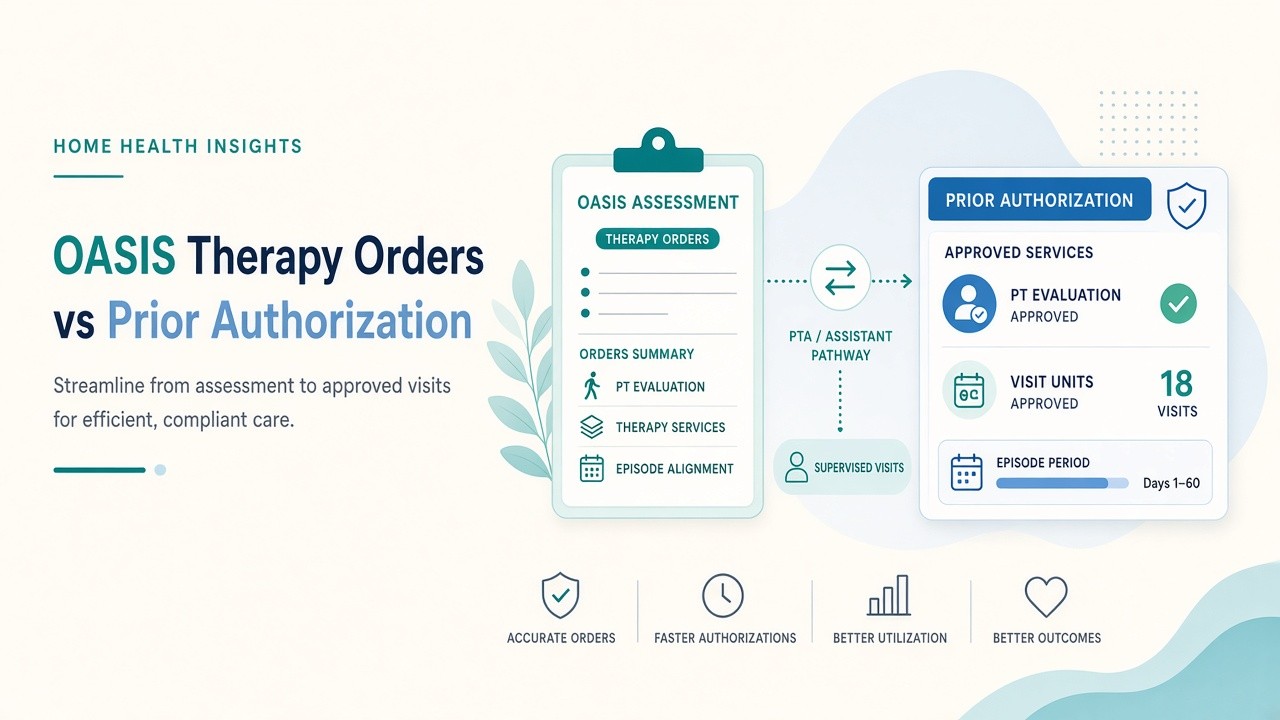
Home health teams often treat OASIS timing and prior auth as two separate tracks. Clinically they are related. Operationally they collide.
OASIS drives episode timing, visit planning, and how the plan of care is documented. Prior auth, especially with payers that run code-specific processes (Ideal Choice / UCLA-style requests are a common pattern operators talk about), drives whether PT, PTA, and related services will be paid when the assistant is the one in the home.
Miss the code on the auth request and you can still have a clean OASIS, a signed order, and a denied or unpaid visit.
Two clocks that do not automatically sync
OASIS frequency answers: when does this episode start and end, and what assessment window are we in?
Prior auth answers: for these dates, for these codes, for this volume, will the payer accept the service?
Those clocks only line up if someone makes them line up. Common failure modes:
- Auth requested for dates that do not match the episode window the OASIS actually established
- PT evaluation requested, but PTA (G0157) left off even though assistants will treat under the plan
- Units requested for eval only, with no room for follow-up treatment visits
- Auth approved for one discipline code set while the plan of care assumes a broader mix
- Clinical changes mid-episode without a matching auth update
None of that is exotic. It is ordinary home health operations under payers that want code-level detail.
Why PTA / G0157 gets dropped
PTA coverage is easy to forget on the request because the mental model is “we need PT auth.” The evaluation is the visible event. The assistant visits are assumed.
Payers that require code-specific prior auth do not assume. If G0157 is not on the request, PTA services may not be covered even when the PT eval was approved and the plan of care clearly includes assistant treatment.
When you know assistants may treat, the auth request should usually include:
- PT evaluation (the eval code your payer expects)
- Enough treatment units for the planned frequency and duration
- PTA / G0157 when PTA visits are part of how the episode will actually be staffed
Leaving G0157 off is not a documentation nicety. It is a coverage gap waiting for the first PTA visit.
Match episode dates on purpose
Date mismatch is the other quiet killer.
If OASIS sets an episode start that does not match what went on the prior auth, visits near the edges become arguments. If the auth ends before the episode ends, later visits sit outside the approved window. If the auth starts after care already began, early visits are unprotected.
A practical checklist before the UCLA-style (or similar code-specific) request goes out:
- Confirm episode start and end from the OASIS / episode record
- Align auth date range to that episode window (or the payer’s required subset of it)
- List the therapy codes that will actually be used, not only the eval
- Include PTA (G0157) when assistants may treat
- Request units that match planned frequency, with a little operational headroom where the payer allows it
- Tie the request back to signed orders and the plan of care so clinical and billing tell the same story
That is discipline, not paperwork theater.
Documentation and orders are the hinge
Prior auth fails less often when documentation and orders are treated as the source of truth for what will be requested.
That means:
- Orders that name the discipline mix you intend to deliver
- Visit plans that make assistant involvement visible early
- OASIS and episode dates that billing and auth staff can see without hunting
- A clear handoff so the person submitting auth is not guessing from a partial message
Home Health Engine sits in that documentation and orders lane: helping agencies keep episode timing, orders, and discipline planning coherent enough that prior auth requests can be built from the record instead of from memory. Soft mention only. The payer rules still win. Your process has to meet them.
What to do on the next Ideal Choice / UCLA-style request
Before the next code-specific auth goes out, run a five-minute scrub:
- Does the date range match the episode the OASIS established?
- Is PT eval on the request?
- Are treatment units sufficient for the planned visits?
- Is PTA / G0157 included if assistants may treat?
- Do signed orders support what you are asking the payer to approve?
If any answer is no, fix the request before it leaves. Fixing after denial is slower and more expensive than fixing before submission.
Bottom line
OASIS frequency and prior auth are not the same workflow, but they share the same episode. When payers want code-specific auth, leaving PTA / G0157 off the UCLA-style request is a predictable miss. Match dates, request eval plus enough units, include G0157 when assistants may treat, and build the request from orders and documentation, not from assumption.
Learn more about Home Health Engine documentation and orders: https://homehealthengine.com